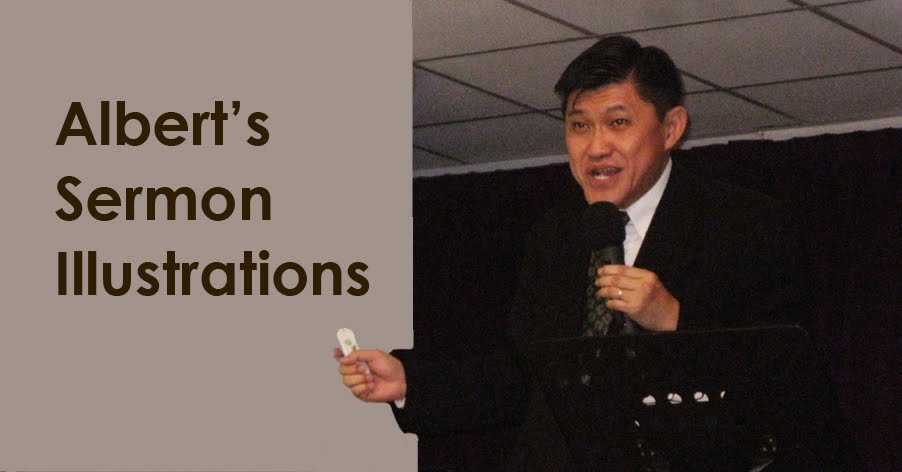
Welcome to Albert's Sermon Illustrations

In this blog, I have collected many stories, quotes, jokes and ideas that I use regularly in my sermons.I have tried to put in the sources and origins of these illustrations. If I have missed some or gotten the wrong sources, please let me know. I will update them. Feel free to use these illustrations for the glory of God. If you have some illustrations that you like to contribute, kindly add them to my blog, so that I and others may benefit from them. God bless!
Reverend Albert Kang

P/S: This is a free site and thus it has advertisements that are not in the blogger's control. If some of them are offensive, please ignore them. Thank you for your understanding.

Monday, December 13, 2010

The Contented Fisherman

Philip Parham tells the story of a rich industrialist who was disturbed to find a fisherman sitting lazily beside his boat. 

"Why aren't you out there fishing?" he asked. 

"Because I've caught enough fish for today," said the fisherman. 

"Why don't you catch more fish than you need?' the rich man asked. 

"What would I do with them?" 

"You could earn more money," came the impatient reply, "and buy a better boat so you could go deeper and catch more fish. You could purchase nylon nets, catch even more fish, and make more money. Soon you'd have a fleet of boats and be rich like me." 

The fisherman asked, "Then what would I do?" 

"You could sit down and enjoy life," said the industrialist. 

"What do you think I'm doing now?" the fisherman replied as he looked placidly out to sea. 

Our Daily Bread, May 18, 1994.

How Many Things Are Absolutely Essential?

In the fifth century, a man named Arenius determined to live a holy life. So he abandoned the conforms of Egyptian society to follow an austere lifestyle in the desert. 

Yet whenever he visited the great city of Alexandria, he spent time wandering through its bazaars. Asked why, he explained that his heart rejoiced at the sight of all the things he didn't need. 

Those of us who live in a society flooded with goods and gadgets need to ponder the example of that desert dweller. A typical supermarket in the United States in 1976 stocked 9,000 articles; today it carries 30,000. How many of them are absolutely essential? How many superfluous?  
Our Daily Bread, May 26, 1994.

When Diamonds Lost Their Value

Aron Weingarten brings the yellow diamond up to the stainless steel jeweler's loupe he holds against his eye. We are in Antwerp, Belgium, in Weingarten's marbled and gilded living room on the edge of the city's gem district, the center of the diamond universe. 

Nearly 80 percent of the world's rough and polished diamonds move through the hands of Belgian gem traders like Weingarten, a dealer who wears the thick beard and black suit of the Hasidim.
David Clugston
David Clugston
Yellow diamonds manufactured by Gemesis, the first company to market gem-quality synthetic stones. The largest grow to 3 carats.
"This is very rare stone," he says, almost to himself, in thickly accented English. "Yellow diamonds of this color are very hard to find. It is probably worth 10, maybe 15 thousand dollars."
"I have two more exactly like it in my pocket," I tell him.

He puts the diamond down and looks at me seriously for the first time. I place the other two stones on the table. They are all the same color and size. To find three nearly identical yellow diamonds is like flipping a coin 10,000 times and never seeing tails.

"These are cubic zirconium?" Weingarten says without much hope.

"No, they're real," I tell him. "But they were made by a machine in Florida for less than a hundred dollars."

Weingarten shifts uncomfortably in his chair and stares at the glittering gems on his dining room table. "Unless they can be detected," he says, "these stones will bankrupt the industry."

Ian White
Ian White
A microwave plasma tool at the Naval Research Lab, used to create diamonds for high-temperature semiconductor experiments.
Put pure carbon under enough heat and pressure - say, 2,200 degrees Fahrenheit and 50,000 atmospheres - and it will crystallize into the hardest material known. Those were the conditions that first forged diamonds deep in Earth's mantle 3.3 billion years ago. Replicating that environment in a lab isn't easy, but that hasn't kept dreamers from trying. Since the mid-19th century, dozens of these modern alchemists have been injured in accidents and explosions while attempting to manufacture diamonds.

Many people have placed great value in diamonds. Some of them are storing many of these hard carbons in the vaults. Imagine the disappointment when they discover that what they have deemed as valuable have become almost worthless. 

What are you placing your emphasis upon in this life? Are you seeking the eternal or just dabbling with the temporal things of life? The real treasures are found in heaven and nothing in this material world can even stand in comparison.

Adapted from an article by Joshua Davis
Sunday, December 12, 2010

I Know Them

Jesus says, "My sheep hear my voice. I know them, and they follow me. I give them eternal life, and they will never perish".John 10:27-28

We expect Jesus to say that the sheep follow Him because they know Him, but instead He says that they follow Him because He knows them. We long to be known—to be understood at the deepest levels.

(Donovan)

A fifth century prayer:

O Lord Jesus Christ,
Thou Good Shepherd of the sheep,
who camest to seek the lost,
and to gather them into Thy fold,
have compassion upon those
who have wandered from Thee,
feed those who hunger,
cause the weary to lie in Thy pastures,
bind up those who are with broken heart,
and strengthen those who are weak,
that we, relying on Thy care
and being comforted by Thy love,
may abide in Thy guidance to our lives' end.
Amen.

Why Ask Me?


An Amish man was once asked by an enthusiastic young evangelist whether he had been saved, and whether he had accepted Jesus Christ as his Lord and Savior?

The gentleman replied,
"Why do you ask me such a thing? I could tell you anything. Here are the names of my banker, my grocer, and my farm hands. Ask them if I've been saved."

Friday, December 10, 2010

Deep Rooted and Well Connected

The biggest trees in the world are in northern California. They are a type of redwood called the sequoia. They are over 300 feet high, and some are 100 feet in circumference. Not only are they big, they're also old. 

Botanists tell us that some of these trees are over 4,000 years old! That means that at the time that Jesus Christ was teaching in Galilee, some of them were already 100 feet high. And they're still there today!

The reason they've remained there that long is that their roots go down deep into the earth, and they also intertwine around the roots of the other Sequoia trees. They are all interconnected. This makes them strong against the winds that blow in that area.

Likewise, well-connected believers in the body of Christ will stand up to the winds that blow through their lives, and the trials that come their way.

Adapted from 'Well Connected' by Skip Heitzig

Thursday, December 9, 2010

No Encouragement

Alexandra Kropotkin, in an article titled, "Homemade", described the death of her friend as follows: 

One day a millionaire of my acquaintance, whose pride it was never to offer a tip for any service, faced an unforgettable tragedy. His chief accountant committed suicide. 

The books were found to be in perfect order; the affairs of the dead man, a modest bachelor, were prosperous and calm. 

The only letter left by the accountant was a brief note to his millionaire employer. It read: "In 30 years I have never had one word of encouragement. I'm fed up." 

Do we often say thank you and give a word of encouragement to our spouse, our children, our friends, our employer, and to our employees? If we all do this on a daily basis, we can make an impact on the world in which we live. Whether it is a kind word or a kind deed, in the words of Charles Dudley Warner, "It is one of the beautiful compensations of this life that no one can sincerely try to help another without helping himself." 

Adapted from Dick Innes