Welcome to Albert's Sermon Illustrations

In this blog, I have collected many stories, quotes, jokes and ideas that I use regularly in my sermons.I have tried to put in the sources and origins of these illustrations. If I have missed some or gotten the wrong sources, please let me know. I will update them. Feel free to use these illustrations for the glory of God. If you have some illustrations that you like to contribute, kindly add them to my blog, so that I and others may benefit from them. God bless!
Reverend Albert Kang

P/S: This is a free site and thus it has advertisements that are not in the blogger's control. If some of them are offensive, please ignore them. Thank you for your understanding.
Showing posts with label China. Show all posts

Monday, February 8, 2021

How Should Christians Respond In The End Times?


As we look at the cataclysmic situations in the world, most of us would naturally figure them to be the preludes of the End Times. Many are happy that Jesus will be coming back soon but many are afraid of the persecution and suffering that would come before Christ’s return. In fact, some believers are selling their homes in the urban areas and moving to rural areas – remote countryside, forested mountains or even to the deserts. Some are stockpiling food and learning how to grow and preserve foods. Many of these are even buying weapons so that they can protect themselves. 

The question is whether God wants His Church to run and hide when the situation becomes bad or that His Church should stay and continue to minister to the people? We do not need to look far to see what we should do during such cataclysmic time – just look at how the churches not only survive but thrive in the Communist countries around us. For example, back in the 1970s, we as young overseas Chinese Christians, were praying and fasting for China because we thought that the Communists had managed to totally destroy Christianity in China. But, in the 1980s, we received good news that in spite of not having missionaries, the Church of Jesus Christ had survived. 

The Chinese believers went through their own Tribulation for more than thirty years and they did not only survive but thrive. And from a mere one million believers before the Communist’s rule to now over 100 million believers. How did they do it? 

At the beginning of the persecution in 1951, majority of the pastors and elders were arrested and imprisoned. These people were arrested on fabricated charges of crimes and that they were falsely accused as counter-revolutionary activists.

The climax of the persecution came in 1966 with the great proletarian cultural revolution. By that time, organised Christianity had been totally demolished and many of the Christian leaders were arrested and subsequently executed. 

What were left behind were mostly the women and their children who went underground to form the underground churches. It was in these dire circumstances that the Church was purified and cleansed. Those who could not take the persecution left the faith. There were also traitors and betrayers who sold the safety of their brothers and sisters so as to secure safe passage for themselves. 

When I was in China in the late 1980s, I personally listened to testimonies from the persecuted believers about how they survived and thrived in the face of danger and death. They worshipped in the cold forest at three in the dark early morning and some worshipped in secluded caves. They did not seek just to survive but to be able to worship the Lord and also to share the Gospel.

How did they physically survive? There were stories about how the urban Chinese believers who escaped to the rural areas learned from the locals how to survive in the harsh conditions of the countryside. Many of them also learned about God’s natural ways of treating infirmities with herbal and traditional methods. When I was in the military, basic jungle survival method was taught to all recruits but we rarely needed to use it. However, those in Commando training, were put to the test because they were left in an isolated island to survive on their own for a week. I heard that each trainee had only a hunting knife and a small amount of ration. The idea of learning how to grow vegetables or hunt animals is of course useful, if one has to really live in the jungle. These would of course be interesting courses to take even in peacetime.

Back to the Chinese Church that survived the persecution – while I was in one underground church, the Elders asked me to lay hands and pray for a sister who was to take the place of her father in the ministry. Apparently, the father was killed by the Communists while in prison and now his place of eldership in the underground was vacant. She was to take his place and face the danger that her father had faced. There was a particular sadness in my heart because I felt like I was ordaining her to be martyred for Christ.

What should we do in the face of persecution of the End Times?

When we look into the Bible, we should be thankful that the Apostle Peter did address this matter of how to face the End Times. Writing specifically about this matter, Peter revealed what God had shown him - “the heavens will pass away with a great noise, and the elements will melt with fervent heat, [and] both the earth and the works that are in it will be burned up.”

He added. “Since all these things will be dissolved, what manner of persons ought you to be in holy conduct and godliness, looking for and hastening the coming of the day of God, because of which the heavens will be dissolved, being on fire, and the elements will melt with fervent heat?” (2 Peter 3:10-12).

Please note that Peter did not suggest that all Christians should head for the jungles or hills in order to hide from persecution. He did not suggest that believers should be isolated from the ministries that God has assigned the Church to do. Throughout the history of Christianity, the believers who ultimately made an impact for the Kingdom of God were not the ones with the “fortress mentality”. The early disciples were not exactly brave and they were found together praying in the upper room. When the Holy Spirit came upon them there was such a transformation. (Acts 1-2). Were they persecuted after the Holy Spirit came? The fact is that the persecution was intense so much so that believers like Stephen and James were murdered for their faith. Many others were arrested and put in prison. In the midst of the heavy persecution, they continued to preach the Gospel. There was no stockpiling of food or weapons in a fortress. However, the believers did move from one place to another. In the process, they spread the Gospel further and wider to other cities and even countries.

The fortress-mentality is for people who do not see life as being eternal. Sadly, for them, this temporal life is the only one that they treasure and so they have to sustain it at all cost. Basing upon the revelation of Peter, all believers who are going through the End Times can do one thing, apart from worrying about food and drink, and that is to practice holiness and do good to others wherever and whenever we can. Indeed, we are supposed to do the works of the Kingdom of God “while it is day” (John 9:4). The Apostle Paul also received the same revelation from the Lord: “Therefore, as we have opportunity, let us do good to all, especially to those who are of the household of faith” (Galatians 6:10).

I hope this clarifies and answers some of your questions about what we should do during the End Times. Thanks for reading.

Pastor Albert Kang


Thursday, March 26, 2020

Wang Ming Dao - No More A Judas

Wang Ming Dao and his wife, Liu Jingwen

Reverend Wang Ming Dao (王明道) served as the Pastor of Christian Tabernacle, Peking’s largest church. During Communist's persecution, he was thrown into prison because of his testimony and ministry. At the hands of his perpetrators, he was tortured for his faith.

Fearing even greater suffering, Dao recanted his belief in Christ and was released by the authorities. He quickly regretted his decision and was seen walking the streets of the city weeping and mumbling, “I am Judas! I have betrayed my Lord!”

Within a few weeks, he was unable to bear the guilt and shame any longer. He returned to the Communist authorities, confessed his faith in Christ, and asked to be put back in prison.

For the next twenty-seven years, he suffered the abuse of prison life but never again entertained the thought of denying his Lord. When Dao was released at the end of his life, the Chinese church considered him a hero who had given strength and assurance to the many who faced the perpetual threat of persecution and imprisonment.

Enduring faith will experience doubts, struggles, and disappointment. It happened to John the Baptist, to Paul, to Jesus and it will happen to every person who seeks to walk in Christ-like obedience. In times of spiritual crisis, may we be inspired by both the success and failure of people like Wang Ming Dao.
The Vision of His Glory, Anne Graham Lotz, 1996, p. 81

Sunday, October 4, 2015

God of Ample Means


Missionary statesman, Hudson Taylor, had complete trust in God's faithfulness. 

In his journal he wrote: "Our heavenly Father is a very experienced One. He knows very well that His children wake up with a good appetite every morning...He sustained 3 million Israelites in the wilderness for 40 years. 

We do not expect He will send 3 million missionaries to China; but if He did, He would have ample means to sustain them all.

Depend on it, God's work done in God's way will never lack God's supply.

Our Daily Bread, May 16, 1992.

Sunday, August 18, 2013

A Pair of Glasses Heading for China


My mother's father worked as a carpenter. On this particular day, he was building some crates for the clothes his church was sending to orphanages in China. On his way home, he reached into his shirt pocket to find his glasses, but they were gone. When he mentally replayed his earlier actions, he realized what had happened; the glasses had slipped out of his pocket unnoticed and fallen into one of the crates, which he had nailed shut. His brand new glasses were heading for China! 

The Great Depression was at its height and Grandpa had six children. He had spent $20 for those glasses that very morning. He was really upset by the thought of having to buy another pair. "It's not fair," he told God as he drove home in frustration. "I've been very faithful in giving of my time and money to your work, and now this." 

Months later, the director of the orphanage was on furlough in the United States. He wanted to visit all the churches that supported him in China, so he came to speak oneSunday at my grandfather's small church in Chicago. 

The missionary began by thanking the people for their faithfulness in supporting the orphanage. "But most of all," he said, "I must thank you for the glasses you sent last year. You see, the Communists had just swept through the orphanage, destroying everything, including my glasses. I was desperate. Even if I had the money, there was simply no way of replacing those glasses. Along with not being able to see well, I experienced headaches every day, so my coworkers and I were much in prayer about this. Then your crates arrived. When my staff removed the covers, they found a pair of glasses wedged between two blankets. 

The missionary paused long enough to let his words sink in. Then, still gripped with the wonder of it all, he continued: "Folks, when I tried on the glasses, it was as though they had been custom made just for me! I want to thank you for being a part of that." 

The people listened, happy for the miraculous glasses. But the missionary surely must have confused their church with another, they thought. There were no glasses on their list of items to be sent overseas. But sitting quietly in the back, with tears streaming down his face, an ordinary carpenter realized the Master Carpenter had used him in an extraordinary way. 

There are times we want to blame God instead of thanking him! Perhaps it is something we ought to try more often, "Thank you, God, for not allowing my car to start this morning." He may have been saving your life from a car accident. "Lord Jesus, thank you for letting me lose my glasses; I'm sure they'll be put to good use or there is a lesson to be learned." 

I have to remember this in these times of trial with my own family. 

May GOD bless your week. Look for the perfect mistakes!

Wednesday, July 10, 2013

The Fall and Rise of Wang Ming Dao

Pastor Wang Ming Dao

The Fall and Rise of Wang Ming Dao
Georgina Giles

The year was 1949 and the first unified central government for forty years was in power in China. Christian believers were fearful.

At the Peking (Beijing) Christian Tabernacle, the congregation prepared itself for Communist rule. Wang Ming Dao, the pastor, continued to hold tenaciously to Scripture. The Christian, he affirmed, should obey the authorities (Romans 13:1-7 ). But if ordered to go against God’s inspired Word, the Bible, then it was God’s Word that must be observed.

The ‘Three Self’ Movement
Wang Ming Dao knew the greatest threat that confronted the church would come from within. A man called Wu Yaozong, a little known YMCA secretary having strong sympathies with Communism, seized his opportunity.

Over the years many had recognised a prophetic ring in Wang Ming Dao’s words. ‘From a man with a selfish heart’, he had written, ‘any terrible act can emerge. Anyone looking for selfish gain can lie, cheat, practise evil and plot for his self interest. The majority of sins in this world issue from people who are out for selfish gain’.

Wu Yaozong approached Zhou Enlai, the Chinese premier. With his and Mao-Tse Tung’s full support, Wu drew up a ‘Christian Manifesto’. This called for the church to sever all ties with Western imperialism and purge itself of everything connected with it. The church must be self-governing, self-supporting and self-propagating. Thus was born the government-sponsored Three Self Patriotic movement (‘TSPM’), and hundreds of thousands of Christians throughout China gave it their support. Wu Yaozong rose rapidly to power.

Adverse Effects

Wang Ming Dao firmly believed in the separation of church and state. He recognised that the aim of the movement was to bring the church under state control.

Besides, the Christian Tabernacle had always been independent of Western aid or connection. There was no need for Wang to join. All his deepest convictions were in conflict with the beliefs propagated by Wu Yaozong and other leaders in the TSPM. Wu wrote in an article: ‘The incarnation, the virgin birth, resurrection, Trinity, last judgement, Second Coming etc., these are irrational and mysterious beliefs which cannot be understood or explained … no matter how hard I try, I cannot accept such beliefs’. Wang Ming Dao steadfastly refused to join the TSPM. He could act in no other way.

Meanwhile the churches that had joined the movement began to feel its adverse effects. The formidable ‘accusation meetings’, already a feature of the Communist secular world were introduced into the church. Pastors who had been linked with foreign missions were isolated, and their congregations encouraged to denounce them.

Another Gospel
All over China, churches were torn apart. The Peking Christian Tabernacle was like an oasis in a spiritual desert, where pure biblical gospel preaching could still be heard.

Wang Ming Dao laboured night and day, setting up his own printing press to continue publication of the Spiritual Food Quarterly. His uncompromising stand on biblical truth strengthened Christians throughout the land.

Between 1951 and 1954, he published many books proclaiming the gospel and speaking out against the modernists. Those who preach the ‘social gospel’, he pointed out, ignore the essential atoning work of Christ for the individual’s eternal salvation and the purifying effect it has in this life. They seek to transform society and establish the ‘kingdom of heaven’ in this world.

But this, taught Wang, was ‘another gospel’ (Galatians 1:9 ). Such people have never put their own trust in Jesus. Men and women need to know the true gospel for their eternal safety and blessing.

Alarm Bells

The TSPM ground its teeth. Its leaders deeply resented the man who was ‘an iron pillar against which the whole land could not prevail’. All they could do was to mount a personal attack on Wang.

In 1954 the TSPM ordered all churches in Beijing to send delegates to an ‘accusation meeting’ against Wang Ming Dao. Leslie Lyall (OMF) writes, ‘it would be difficult to find fault with him, for he practised what he preached: upright, disciplined living’.

Throughout the meeting, Wang did not speak a word. Imprisonment or the death sentence were called for. The congregation sat silent. Many wept. No penalty could be imposed.

So Ming Dao continued to preach. The crowds were larger than ever. The evangelistic meetings in January 1955, says Leslie Lyall, ‘were probably the most fruitful he had ever conducted’.

Then students, as students will, daringly started their ‘Oppose the persecution of Wang Ming Dao’ campaign. It received wide support all over China. Alarm bells began to ring in high places. Their plan to subjugate the church to Communist control was under threat.

Accusation meetings were arranged against Wang Ming Dao across the whole of China. Nevertheless, in two weeks of meetings in the Christian Tabernacle in July 1955, attendance broke all records. Wang’s important article, We, because of Faith, had been published. With powerful logic, he dealt with the arguments of the modernists. He explained how they overturned the Bible and the Christ of the Bible. Was he being uncharitable, he asked, if he called them ‘the party of unbelievers’?

Imprisoned
The Three-Self controlled magazine (the Tianfeng) branded Wang Ming Dao ‘a criminal of the Chinese people, a criminal in the church and a criminal in history’.

On 7 August 1955, Wang preached his last sermon in the church. For thirty years he had laboured tirelessly to show his country where her true hope lay, namely, in the atoning work of Christ and obedience to his Word. His final sermon showed that the TSPM church leaders had betrayed Christ in China.

At midnight the police arrived and Wang was thrown into prison without a conviction. He was parted from his wife and did not realise that she had been imprisoned too.

To the Communists, Wang Ming Dao’s refusal to join the TSPM was a counter-revolutionary act, the very worst of crimes. They could not, of course, understand that he was called by God to summon the church to chastity to Christ.

Wang shared a filthy cell with two other prisoners. From his daily interrogations, Wang was returned to his cell to be taunted with descriptions of torture reserved for preachers, and to be beaten and pressurised by his fellow prisoners to confess his ‘crimes’.

Freedom and Rearrest
The authorities used every device to break down the resistance of this powerful opponent to their scheme. After a year of tremendous pressure, Wang was informed of a wave of arrests of Bible-believing Christians sympathetic to him. Then news came of Jing Wun’s plight. She, too, was in detention, unable to eat the coarse prison food because of her poor health. China’s ‘iron man’ began to weaken. He ‘confessed’ to crimes he had not committed, and agreed to join the TSPM and preach for them. He signed a document stating he was a counter-revolutionary, and he and Jing Wun were freed.

Then began the darkest six months in Wang Ming Dao’s life. The TSPM leaders were elated. They waited eagerly to claim the lifeless jewel that would crown their movement. But with a mind deranged with guilt and sorrow for the denial of his Lord, Wang never did join or preach for the TSPM. With the same tender love the Lord had shown to Peter, Wang was granted time to regain normality by a period of illness.

He informed the government he could not join, Jing Wun affording outstanding support to her husband. Exactly seven months after their release, Wang Ming Dao and Jing Wun were re-arrested.

Restored in Spirit

By the 1960s, Mao Tse Tung’s disastrous policies, along with natural calamities, left millions starving in a terrible famine. All, except high government officers, were affected. Officials at the bottom level were blamed for Mao’s mistakes.

While some ‘counter-revolutionaries’ were released at this time, Wang Ming Dao received the sentence he most dreaded — life imprisonment. Earlier, the Beijing People’s Court had drawn up charges against him. The recorded evidence stated that Wang Ming Dao and his wife had undermined the TSPM set up by Chinese Christians, and had accused the TSPM of committing adultery with the world.

It was now that God met with Wang Ming Dao and restored him to his brightest hour. A scripture he had learned many years before was brought by the Holy Spirit to his remembrance: ‘When I fall I shall arise, when I sit in darkness the Lord will be a light unto me. I will bear the indignation of the Lord because I have sinned against him until he pleads my cause and executes judgement for me’ (Micah 7:7 ).

One Great Prison
Through the next sixteen and a half years Ming Dao was to suffer solitary confinement, torture, and the horror of five months of daily meetings attempting to force confessions from him.

But the Lord stood by him and gave him the victory through his Word. Never again was he to fall. Though Wang Dao’s voice was silenced, his life still spoke throughout the land.

During this time all China had become one great prison from which there was no escape. The ‘little red book’ of Mao’s teachings was in everyone’s hands. As the Cultural Revolution flourished, everyone spied on his neighbour and almost every family suffered at least one death.

Preaching Again

In Beijing, more than anywhere else, the youthful Red Guards were authorised to terrorise intellectuals. Had Wang Ming Dao still been there, he would have been targeted for death. The ancient city walls were demolished, as things old and beautiful were destroyed to make way for Mao’s new China. Even the TSPM ceased to function.

Gradually it became clear that Mao had failed the nation. His ‘little red book’ was laid aside. God had destroyed the wisdom of the wise (1 Corinthians 1:19 ). In 1976 Mao Tse Tung died, and his revolution died with him.

Prison doors opened, and seventy-nine-year-old Wang Ming Dao, now nearly blind and very deaf, was free again. In his little home in Shanghai, and always mindful of his fall, he began again to preach the Holy Scriptures which are able to make one ‘wise unto salvation’ (2 Timothy 3:15 ). He died in 1991, a radiant witness to his Saviour.

The healthy state of the vast house-church movement in China today, and the breathtaking increase of true Bible-believing Christians there, are not unrelated to the life and work of Wang Ming Dao. He has emerged as the greatest Chinese Christian leader of the twentieth century.

Friday, June 28, 2013

Auntie Deborah Wang - Never Alone

Auntie Deborah and her famous husband, Pastor Wang Ming Dao


By Dr. Harold J. Sala.

Never will I leave you; never will I forsake you. Hebrews 13:5

It is said that behind every great man is a great woman. Unquestionably, that was true of Wang Ming Dao. The woman, Deborah Wang, a frail but vibrant saint, endured what no woman should ever have to face. Her husband, Wang Ming Dao, was one of the unofficial architects of the house church movement in China, and when her husband was sentenced to prison for what the Chinese government termed "anti-revolutionary" activities, his wife followed.

For 20 years, this saintly woman was in prison, facing the bitter cold of northern Chinese winters with thin clothes and insufficient food, but she never complained.

In 1989 I met the Wangs for the first time. I'll never forget the afternoon I sat in the humble little apartment in Shanghai and listened to them recount their experiences. While I deeply admired and venerated Wang Ming Dao, I was drawn to the strength of this saintly woman whose smile came from her heart. As she talked about the years of imprisonment, I asked, "Did you ever lose hope?" (After all, 20 years of separation, with very little news and few letters from the one you loved so deeply, is a long time.) Her eyes spoke far more than her answer as she said, "No, never!"

After the Wangs were released from prison, their home became a refuge for those who needed encouragement and counsel. God only knows how many cups of tea Auntie Wang (as her friends called her) served to weary men and women who traipsed up the stairs to their flat for encouragement and help.

What a woman! Two weeks after her husband passed away, at the age of 91, I again visited Auntie Wang. The ashes of her late husband were in an urn on the table near the chair which Brother Wang had used as a pulpit to share the Word. My son-in-law and I sought to comfort her, quoting some of my favorite passages of Scripture. But it was Auntie Wang who really comforted us. She was in her mid-eighties. Successful surgery a few months before had removed one of the cataracts from her eyes, and few details escaped her. When a small piece of paper fell from my lap, it was she who quickly leaned over to pick it up.

"Auntie Wang," I said, "I will pray that you will not be lonely." Pausing for just a moment she spoke with a clear and resolute tone of voice, "I will not be lonely; I was not lonely before." It was what she didn't say that spoke the loudest. On a previous visit, she told me that she had seen her husband but three times during the twenty years of imprisonment. That one word, "before," said so much. I knew what she was thinking.

Those words rang in my ears when a close friend told how Deborah Wang had developed pneumonia and was taken to a Shanghai hospital. With no rooms available, she was given a temporary bed in a hallway, and there in the early hours of the morning on April 18, 1992, she met Him who had been her stay and companion for so many years. As the leaves of the trees were budding, following the cold of a Shanghai winter, Deborah Wang made her entrance into the presence of the Lord, where a faithful and devoted husband awaited her.

The saddest part to me was that she couldn't be surrounded by friends and flowers when the angel sweetly took her hand and escorted her across the threshold of death. But I am sure of one fact: While she was alone, she was not lonely. She had the promise of her Lord who said, "And surely I am with you, always...." (Matthew 28:20). Deborah Wang experienced that, both in life and in death.
Resource reading: Hebrews 13:1-5


Dr. Harold J. Sala, well known speaker, author and Bible teacher, has served as founder and President of Guidelines International, Inc., since 1963. He is the featured speaker on the daily "Guidelines-A Five Minute Commentary on Living" which is broadcast on over 1000 radio stations around the world and translated in over 15 languages. Author of over 40 books published in various languages and hundreds of publications. Residing in Mission Viejo, California, Harold and his wife, Darlene, have three adult children and eight well-loved grandchildren.


Friday, June 7, 2013

Ji Zhiwen 計志文(Andrew Gih) - A Fellow Worker of Evangelist John Sung


Andrew and Dorcas Gih
Ji Zhiwen 計志文(Andrew Gih) 1901-1985

Ji Zhiwen (Andrew Gih) was born on January 10th, 1901, in Shanghai, the oldest son in the family. His father, Ji Youren, a Confucian scholar, opened a school in his home and taught students there. From childhood, Ji Zhiwen received a traditional Confucian education from his father. His mother was a Buddhist, a vegetarian, virtuous and open-minded, though she maintained tablets of ancestors in the home, observed religious festivals, and worshiped the ancestors. Ji Zhiwen in his youth was quiet and reticent, and very awkward in relating to people. In his youth, he would go with his mother to the temple to offer incense and listen to the monk chant the scriptures; he even had an opportunity to skim over the books of gospel, but was totally uninterested and cold towards religion.

Zhiwen’s parents had four sons and three daughters, three of whom died in infancy. As he watched his little brothers’ rigid corpses being placed into square coffins and carried out to be buried by adults and saw the grieved expressions and the tears of the mourners, he couldn’t understand the meaning of death, but the questions of why people die and what happens after death were lodged deeply in his mind.

At the age of twelve, his father came down with a serious illness, which proved to be incurable, and he quickly died. After his father’s death, Zhiwen once again followed his mother around as she rose early and retired late, tilled the field and made clothing, upholding the family all by herself. He often helped her work in the field, spread fertilizer, carry water, etc. Seeing his mother working so hard, he resolved that when he grew up he would certainly make enough money to repay his mother as a filial son.

In order to make ends meet, Ji Zhiwen again became an apprentice in a cloth shop. As he became immersed in business circles, he picked up not a few bad habits. At the age of 18, in order to learn English, he entered a middle school run by Western missionaries (the CIM’s Bethel Secondary School). Although he had absolutely no interest in the religious activities of the school or the Bible class, because of school regulations he had to take his Bible along and participate. Unexpectedly, the Bible became for him a textbook for studying English. The words of Jesus as recorded in the Bible made a deep impression upon him, gradually convincing him of the greatness of Jesus.

Ji Zhiwen became a Christian

One day, a CIM missionary came to preach at the school. His topic was, “All have sinned and fall short of the glory of God.” Ji Zhiwen’s heart was struck by the force of the message and God’s love flooded his heart, convicting him of his sin. That night he kneeled before God for the first time, as he cried with a loud voice, “My God, you are my Savior; have mercy on this sinner!” Immediately, God removed his heavy burden and filled his heart with peace and joy.

He was elected as an officer of the Shanghai post office in 1924, with a handsome salary, a good position in society, and a promising career ahead of him. All this did not satisfy his heart, however. The next year, Wang Zai came to Shanghai for an evangelistic meeting. Hearing him, Ji Zhiwen was moved deeply and requested baptism from Wang Zai. After his baptism Ji was even more hungry for the truth of the Bible, and eagerly took part in every sort of church activity. He gave himself the Bible name, “Andrew,” and resolved to become a man who led others to the Lord. Soon he had led his mother and two younger sisters to believe in Christ. His Buddhist grandmother was a first strongly opposed to the Gospel, but later she joined her family in receiving Christ.

In 1925, at a revival meeting led by the Western missionary John Gu, Ji Zhiwen once again responded to the call of God and made a decision to commit himself to full-time work as a preacher. But how could he explain leaving his well-paying job at the post office? God heard his prayer, however, while he was praying gave him a clear vision, so he finally resigned his position, said “Farewell” to his mother, and entered upon the path of the life as a minister of the Gospel.

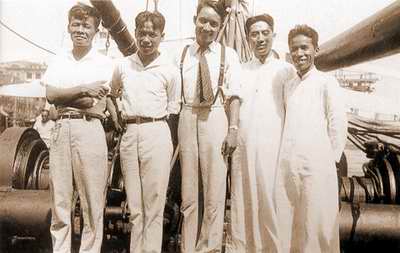
In 1931, John Sung (宋尚節) [1st left] and Andrew Gih (計志文) [2nd from right] formed the Bethel Worldwide Evangelistic Band to reach China for Christ.

He began by associating with the evangelist Mary Stone (Shi Meiyu) and pastor Ding Limei as he learned from their experience in evangelism, accompanying Mary Stone often to many places for revival and evangelistic meetings. In 1926, he received ordination from the Rev. Mr. Sontas. From that time, he began traveling to Guangxi, Guangdong, Fujian, Xiamen and other locations conducting evangelistic and revival meetings. The Holy Spirit was with him, enabling him to preaching with great power resulting in hundreds, even thousands of people repenting and deciding to follow the Lord.

Ji Zhiwen returned to Shanghai from his evangelistic tours on October 1st, 1928, for his wedding to Dorcas Zhang, a fellow member of the Bethel organization, at the Bethel Church. Hardly a week later, the new couple went to the Baptist Church at Hangzhou to preach, spending their honeymoon thus in evangelistic ministry.

The Chinese church experienced a great revival in 1927, which lasted into the 1930s. Ji Zhiwen was among the leaders of this revival movement. In February, 1931, he established the “Bethel Evangelistic Band” in Shanghai. This organization was part of the Methodist Church, prominent members of which included Li Daorong, Lin Jingkang, Nie Ziying, John Shi, and Song Shangjie (John Sung). Beginning February 18, over the next four years they traveled 50,000 kilometers, visited 133 cities, conducted 3389 meetings, and preached the Gospel to 500,000 people, of whom 50,000 made professions of faith. Among those who repented and turned to the Lord were Chinese and foreigners; workers, farmers, business people; youth and soldiers; and corrupt officials, bandits, gangsters, and murderers. Their powerful preaching and personal testimonies brought revival wherever they went. In order to meet the increasing needs of the evangelistic work, they established 10 regional teams in every part of the country for evangelism and revival meetings. In 1933, they even formed “battlefield evangelistic teams” especially to preach the Gospel to officers and soldiers fighting the Japanese. Under their inspiration, many local churches also formed evangelistic teams.

Ji Zhiwen and the Bethel Band not only spread the Gospel fire in both urban and rural areas in the south and north China, but also sowed Gospel seeds in the border areas of Manchuria, Inner Mongolia, Yunnan, Tibet, and Xinjiang. In the latter part of 1938, Ji and Dr. James Edwin Orr passed through Yunnan to Vietnam, evangelizing in Hanoi and Haiphong; they also conducted a nation-wide evangelistic meeting in Saigon, bringing a great revival to the church in Vietnam. In the process of their preaching, they employed personal testimonies, outdoor meetings, large Gospel meetings, as well as revival and spiritual life methods. Miracles often accompanied their proclamation. Ji Zhiwen always ascribed the accomplishments of the Bethel Bands’ endeavors to the work of the Holy Spirit.

As the war against Japan expanded, Ji Zhiwen took the Bethel co-workers, including Mary Stone and Miss Jennie V. Hughes, along with the seminary students and more than 100 orphans, to Hong Kong. In Kowloon he established a church, an elementary school, and an orphanage. The war had created many homeless orphan children; Ji responded to the call of Song Meiling (Madame Chiang Kai-shek) and established orphanages in Hong Kong and Guizhou for these victims of warfare. He later went to America to preach and to promote the needs of orphans, receiving support from American Christian friends, who sponsored more than a thousand orphans as well as providing support for the orphanages opened by Ji. Mrs. Ji returned to Shanghai from Hong Kong, where she rented a three-story building and opened an orphanage on Da Xi Road, obtaining the very effective assistance of Miss Ou Jialing.

In 1943, after Shanghai fell to the Japanese, Ji again led more than a hundred war orphans, seminary students, faculty, and staff in an exodus to Guizhou. After a long and arduous journey, they finally reached the orphanage in Bijie, Guizhou. As a result of the difficulties of the long journey, his tuberculosis flared up, causing him to vomit blood constantly, and forcing him into the hospital for treatment. At this time, he still managed to make it to churches and universities to preach and teach.

From 1946 to 1949, Ji established the Chinese Evangelization Society in Shanghai, undertaking both evangelistic and orphanage work. By the end of 1949, they had already taking in more than 100 orphans. But the new government would not allow private organizations to operate orphanages, so the institution run by Mr. and Mrs. Ji was closed down not long afterwards.

In February of 1949, Ji Zhiwen traveled to America to serve as speaker at the annual meeting of American Christians held in Chicago. Mrs. Ji went to Hong Kong for treatment for tuberculosis. When the political situation in China changed dramatically, the two moved to Hong Kong. Since he could not return to the mainland of China, Ji began holding evangelistic meetings in the Kuai Le (“Happiness”) Theater. Weekly attendance on Sunday mornings was more than 1200 people. In August, 1951, he formally established a church, along with Paul Shen and others. With increasing numbers coming, they took up and offering to build their own meeting place. The structure was completed in October of 1956 and was given the name, “Canaan Church of the Chinese Evangelization Society.”

In 1950, Cassada College in Oregon, America, conferred upon Ji Zhiwen an honorary Doctorate of Letters (D. Litt.).

The Chinese Evangelization Society began its work in Taiwan in 1948 when Paul Shen was sent by Ji Zhiwen to Taichung to establish a ministry there. Beginning with nothing, by 1952 they had erected a meeting hall with a capacity to seat more than 400 people, with the name, Si En Church. In February of 1952, Ji presided at the dedication ceremony. In the following years, the Society opened work in Taipei, Pingtung, Taidung, Yilin, Yilan, Luodong, Gangshan, Hsinchu and other places, and conducted evangelistic work and opened churches among the aboriginal people as well.

In the early 1950s, Ji extended his evangelistic ministry to South East Asia. In the next decade, he engaged in pioneer evangelism in the Philippines, Malaysia, Singapore, Thailand, Vietnam and other countries; built churches; conducted revival and evangelistic meetings. In each place, churches experienced revival, as thousands dedicated themselves to God. Ji Zhiwen’s influence upon Chinese churches in South East Asia was profound. More than that, his journeys took him to more than fifty nations, and he circled the globe more than 15 times.

In the course of his ministry, Ji met the needs of the Chinese churches by establishing theological colleges, including Bethel Seminary in Shanghai, Taichung Bible College, South East Bible College in Indonesia, Hong Kong Bible College, and Bethel Bible College in Thailand, training thousands of preachers as a result. In 1981, in order to honor his work, the South East Bible College in Indonesia dedicated the “Ji Zhiwen Memorial Hall,” a church building with a capacity of more 1,200.

Ji Zhiwen was always a philanthropist, establishing schools, kindergartens, and day care centers for children affected by disasters and for orphans, including “En Ci Orphanage in Macao; Malang Middle School in Indonesia; Holy Word Children’s Home in Taipei; Holy Word Kindergarten in Malaysia, and many more, providing food, clothing, shelter, and education for this homeless young people. He not only saved the lives of thousands, but turned them into people with a sense of responsibility for society.

Ji Zhiwen greatly emphasized Christian literature work, as seen in his establishment of a publishing organization. Already in 1949, he had set up a publications division in the Chinese Evangelization Society; the name was changed to Holy Word Press in June, 1962. It issued “Life Magazine”; Gospel tracts; evangelistic booklets; and Christian books.

Ji Zhiwen went to heaven at age of 85

Ji Zhiwen officially retired at the Los Angeles headquarters of the Chinese Evangelization Society in October, 1978. He had suffered from tuberculosis since youth, often coughing up blood, but God supported him, greatly used him, and accomplished great things through him. On January 30, 1985, he underwent surgery for lung cancer. He died peacefully on February 13th at the age of 85. A memorial service was held for him on February 23rd at Forest Lawn in Glendale, California, at which his co-worker the Rev. Xiao Zhenxiang, presided; Lin Jingkang preached the sermon; Li Qirong sang a solo, “Holy city,” in order to commemorate the life of this faithful and fruitful servant of God.

The Jis had no children. Ji Zhiwen preached mostly in Chinese, though he could preach and teach in English also. Aside from an autobiography, My Wonderful God, he wrote several books in English:Launch Out into the Deep; Twice Born - and Then?; Into God’s Family; and The Fire of Revivalism in Chinese. He was a kind and easy-going person, and usually enjoyed good relationships with his coworkers.