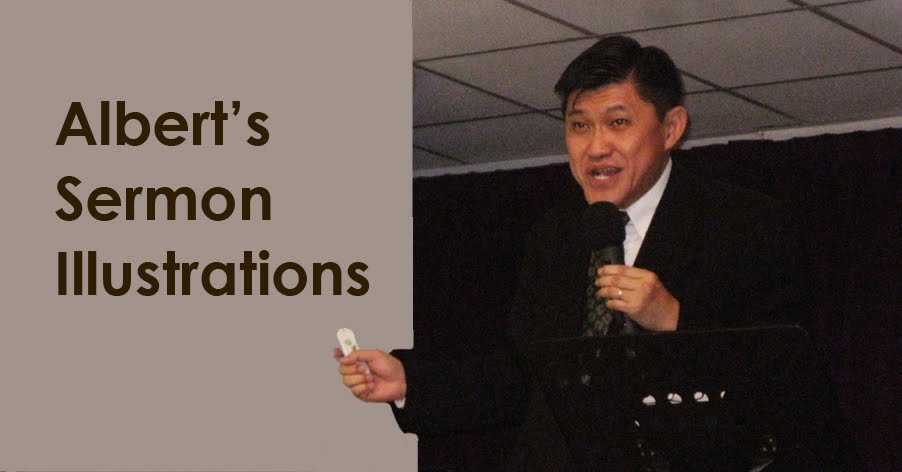
Welcome to Albert's Sermon Illustrations
In this blog, I have collected many stories, quotes, jokes and ideas that I use regularly in my sermons.I have tried to put in the sources and origins of these illustrations. If I have missed some or gotten the wrong sources, please let me know. I will update them. Feel free to use these illustrations for the glory of God. If you have some illustrations that you like to contribute, kindly add them to my blog, so that I and others may benefit from them. God bless!
Reverend Albert Kang
P/S: This is a free site and thus it has advertisements that are not in the blogger's control. If some of them are offensive, please ignore them. Thank you for your understanding.
Wednesday, January 30, 2013
The Caddy
THE CADDY
Two golfers stepped up to the first tee on the St. Andrews course in New York. The older golfer was a kindly man who played a thoughtful, deliberate game. The younger golfer was full of pride and impatience.
On the first hole he sliced, lost his ball in the tall grass, hit another one, & had a score of 8 instead of 4 or 5. And the next hole was even worse.
Frustrated, he began hollering at the caddy: "Keep your eyes peeled. I'm not here to do your job for you!" Thereafter, every bad shot was the caddy's fault! At the end of the first 9 holes, the younger golfer was so upset that he discharged the caddy and carried his own bag. "That caddy made me nervous. He doesn't like me, and I blankety-blank sure don't like him! I say good riddance to him!"
After several more holes had been played without a word, the older golfer broke the silence: "Several years ago a little kid from Yonkers came up here and became a caddy. He was a sweet-natured boy; quick-witted, willing, and had a nose for golf. Everybody liked him. His name was William; he had a clubfoot. But that didn't affect his caddying. It was a pleasure to go out with him."
"A famous doctor, a member of the club, became interested in William and took him South that winter and operated on his foot. When William returned, he went back to caddying. The doctor, however, had to give up golf shortly after that because of his health. And it wasn't long after that when he died.
"Months later I was playing a round with William carrying my bag. It was Spring, the fields and hedges were alive with blossoms. William stopped several times to gather flowers until he had quite a bouquet. 'Who's the girl, William?' I asked. 'I haven't any girl, sir,' he said. 'They're for my friend, the doctor--twice a week I take flowers to his grave.'
"Now that's a caddy worth having," the younger golfer said. "What ever happened to him?" The older man paused and then replied, "For 9 holes he was carrying your bag."
(From a sermon by Melvin Newland, Thanksgiving and Praise, 11/24/2010)
Tuesday, January 29, 2013
The BEST Method for Sharing the Gospel
One day a lady criticized D.L. Moody for his methods of evangelism in attempting to win people to the Lord.
Moody's reply was: “I agree with you. I don’t like the way I do it either. Tell me, how do you do it?”
The lady replied, “I don’t do it.”
Moody retorted, “Then I like my way of doing it better than your way of not doing it.”
A lame method is better than no method at all when explaining the Gospel.
Labels:
Critiques,
Evangelism,
Evangelists,
Gospel,
Moody D.L.
Monday, January 28, 2013
The Farmer and the Preacher
There’s a classic old story about a conversation between a farmer and a preacher. The story goes that the preacher was driving down a country road when he came upon the most beautiful farm he’d ever seen in his lifetime spent traveling rural roads. He could only compare it to a beautiful painting. It was by no means a new farm, but the house and buildings were well constructed and in perfect repair and paint. A garden around the house was filled with flowers and shrubs. A fine row of trees lined each side of the white gravel drive. The fields were beautifully tilled, and a fine herd of fat dairy cattle grazed knee-deep in the pasture. The site was so arresting the preacher stopped to drink it all in. He had been raised on a farm himself, and he knew a great one when he saw it
It was then he noticed the farmer, on a tractor, hard at work, approaching the place where the preacher stood beside his car. When the farmer got closer, the preacher hailed him. The farmer stopped the tractor, idled down the engine, and then shouted a friendly “hello!” The preacher said to him, “My good man, God has certainly blessed you with a magnificent farm.” And then, there was a pause as the farmer took off his cape and shifted in the tractor seat to take a look at his pride and joy. He then looked at the preacher and he said, “Yes, He has, and we’re grateful. But you should have seen this place when He had it all to Himself.”
Well, the preacher looked at the strong, friendly features of the farmer for a moment, smiled, and with a wave of his hand climbed back in his car and continued on his way. And he thought, that man has given me my sermon for next Sunday.
Every farmer along this road and in this country has been blessed with the same land, pretty much, and the same opportunity. Each has worked his farm according to his nature. Every farm, every home of every family in the country is the living reflection of the people who dwell in it. He understood that the land we’re given was not the acres we buy for our farm or the lot on which we build or buy a home, but rather the life we give it, what we do with what we have. Our lives are our plots of ground, and that’s the land we sow and from which we are then obliged to reap the resulting harvest. And the way we’ve sown will be reflected in every department of our lives.
Well, the farmer that the preacher had just talked to would reap an abundant harvest, not just when the time came for gathering his crops, but every time he looked around the place, every time he returned from town to that white gravel drive and trees that lined it and the fine home and gardens that stood at the end of it. He was grateful for what he had. But he knew that it was not what is given us that makes the difference, but rather what we do with it, what we make of what we have. Yes, sir, the preacher thought as he smiled and drove his car along the road to town. He had his sermon for next Sunday, and it would be a good one.
Each one of us is a farmer. Our lives are the plots of ground that have been given to us free and clear. If we’re wise, we too, will reap the abundant harvest, for the planting is left strictly to us.
Earl Nightingale
Labels:
Dedication,
Earl Nightingale,
Faithfulness,
Farmer,
God's Blessings,
Harvest,
Investments,
Pastors
Wednesday, January 23, 2013
The Thread of a Dream
When I was researching the history of the building of the Brooklyn Bridge as a major illustration for the ideas of success and motivation, I became engrossed with the story of how the first bridge was built over the Niagara River near Niagara Falls. You see, to build a bridge over a giant gorge, first you have to get a line over the canyon, from one side to the other. Easier said than done at Niagara Falls.
The engineers couldn’t cross the river in a boat to take the line from one side to the other because the boat would go over the falls. And the airplane hadn’t been invented yet. The distance was also way beyond the bow-and-arrow range, which had been a common method at the time of getting the first line across to build a bridge.
The designing engineer, Charles Ellet, pondered the question until he came up with a revolutionary idea. He decided that, while solving the problem, he would also have some fun and generate some publicity for the project. Ellet sponsored a kite flying contest and offered five dollars to the first person who could fly a kite across the gorge and let it go low enough to the ground for someone to be able to grab the string. In 1849, five dollars was a prize similar to a small lottery today. The boy who won the prize relished his accomplishment until his death, nearly 80 years later.
It all began with an idea and one thin kite string. The kite string was used to pull a cord across, then a line, then a rope. Next came an iron-wire cable and then steel cables, until a structure strong enough to build a suspension bridge was in place.
I’m struck by how that string is like a single thought. The more vivid and clear the thought, and the more you come back to it, the stronger it becomes—like the string to the rope to a cable. Each time you rethink it, dwell on it, or layer it with other thoughts, you are strengthening the structure on which to build your idea, like building a bridge over Niagara Falls. But unlike a kite, there is no string attached to how high and how far your goals may take you. They are limited only by the power of your imagination and the strength of your desire.
Denis Waitley
Labels:
Bridges,
Brooklyn Bridge,
Challenges,
Creativity,
Denis Waitley,
Dreams,
Goals,
Niagara Falls,
Purpose
Tuesday, January 22, 2013
Abundant Rain May Not Be Good
Neil Orchard was talking with a farmer about his soy bean and corn crops.
Rain had been abundant, and the results were evident.
So his comment surprised him: "My crops are especially vulnerable. Even a short drought could have a devastating effect."
"Why?" Orchard asked.
He explained that while we see the frequent rains as a benefit, during that time the plants are not required to push roots deeper in search of water.
The roots remain near the surface. A drought would find the plants unprepared and quickly kill them.
Some Christians receive abundant "rains" of worship, fellowship, and teaching.
Yet when stress enters their lives, many suddenly abandon God or think Him unfaithful.
Their roots have never pushed much below the surface.
Remember this, only roots grown deep into Jesus Christ help us endure times of drought in our lives.
The Roman Soldier's Cloak
"Then the righteous will answer him, 'Lord, when did we see you hungry and feed you, or thirsty and give you something to drink? When did we see you a stranger and invite you in, or needing clothes and clothe you? When did we see you sick or in prison and go to visit you?' The King will reply, 'I tell you the truth, whatever you did for one of the least of these brothers of mine, you did for me.'"
(Matthew 25:37-40)
Dan Vellinga talks about a true soldier of the cross, Martin of Tours. "He was a Roman soldier and a Christian. One cold winter day, as he was entering a city, a beggar stopped him and asked for alms. Martin had no money; but the beggar was blue and shivering with cold and Martin gave what he had. He took off his soldier's coat, worn and frayed as it was; he cut it in two and gave half of it to the beggar man. That night he had a dream. In it he saw the heavenly places and all the angels and Jesus in the midst of them; and Jesus was wearing half of a Roman soldier's cloak. One of the angels said to him, 'Master, why are you wearing that battered old cloak? Who gave it to you?' And Jesus answered softly, 'My servant Martin gave it to me.'"1
Reminder: "Only one life, 'twill soon be past. Only what's done for Christ will last."
1 Dan Vellinga, "What Would You Do?"
Story by Dick Innes
Labels:
Beggar,
Charity,
Jesus Christ,
Kindness,
Roman Soldiers,
Servanthood,
Stranger
Monday, January 21, 2013
The Juggler and the Drunk
Late one night, a Highway Patrol officer pulled over a car for speeding on the Interstate. When the officer asked the driver why he was speeding, the driver answered that he was a magician and a juggler and he was on his way to “Make A Wish” event and didn’t want to be late.
The officer explained to the driver he was fascinated by juggling, and if the driver would do a little juggling for him that he wouldn’t give him a ticket. The driver told the officer that he had already sent all of his equipment ahead, so he didn’t have anything to juggle.
Not deterred, the officer said that he had some flares in the trunk of his patrol car and asked if he could juggle them. The driver said that would be fine, so the officer got three flares, lit them and handed them to the driver.
Meanwhile, the bars had just closed in the nearest town, and a somewhat over-served patron was heading down the Interstate on his way home.
Witnessing the roadside juggling performance, the bar patron pulled off the road and parked carefully behind the patrol car. After watching the juggler for a moment, the tipsy bar patron then went over to the patrol car, opened the rear door and got in.
Observing this, the officer went over to the patrol car, opened the door and asked the man what he thought he was doing. The drunk driver replied, “You might as well just take me to jail, cause there’s no way I will never pass that drunk-driving test."
Subscribe to:
Posts (Atom)


